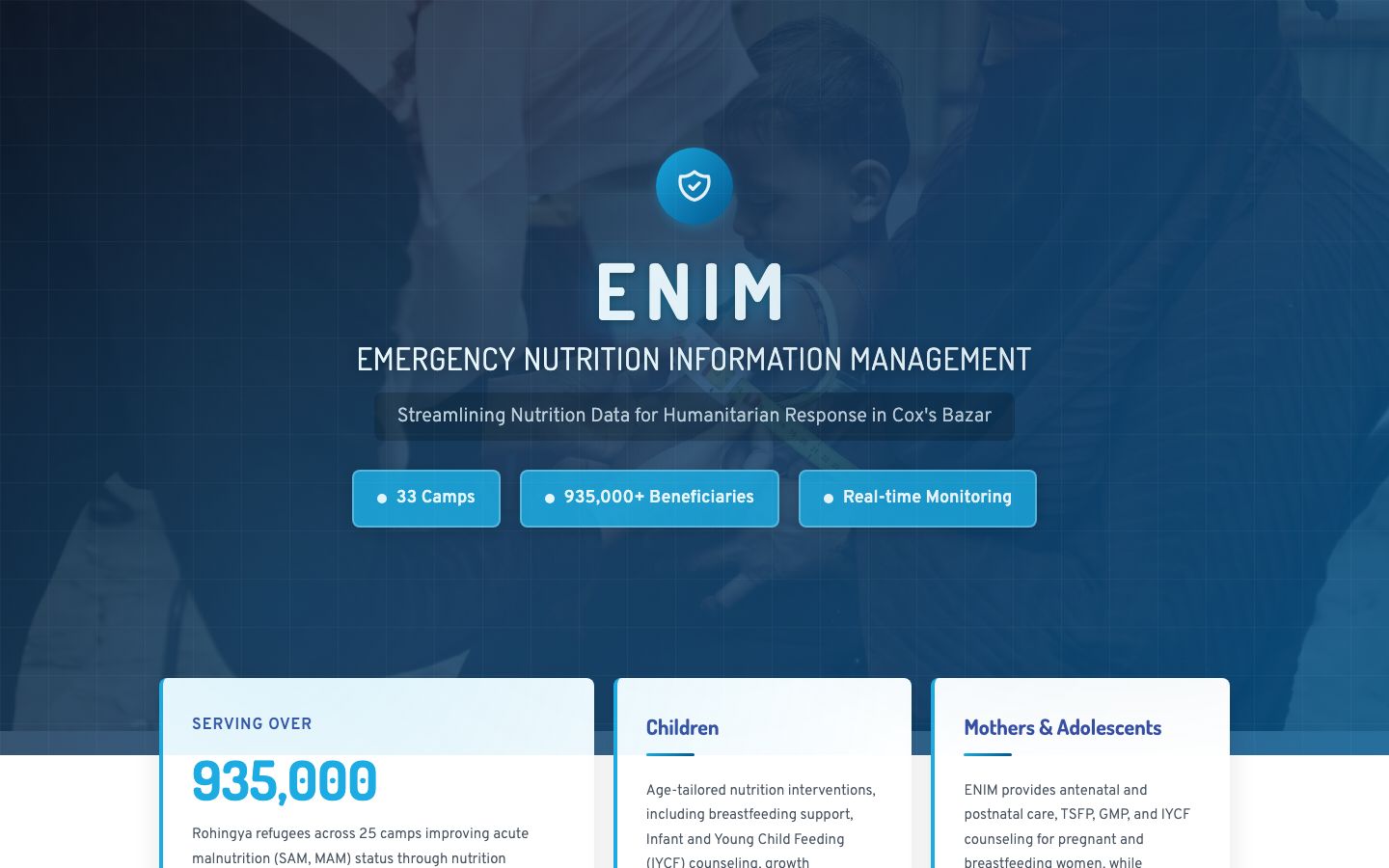
ENIM
UNICEF and the Nutrition Sector, Cox's Bazar
The nutrition information system for the Rohingya response in Cox's Bazar: one case-based record for more than 935,000 people across 33 camps, with real-time monitoring.
Read the case study: ENIM →Health, humanitarian and public sector
Information systems for UN agencies, INGOs and local NGOs working with Forcibly Displaced Myanmar Nationals in Cox's Bazar. Each beneficiary has one record, field data works offline, and partners report from one data entry.
Who we work with: UNICEF, Nutrition Sector, Cox's Bazar
The short version
Cox's Bazar hosts more than 935,000 Rohingya refugees across 33 camps. Much of the response has relied on paper registers and separate spreadsheets. Records do not follow a beneficiary between services, and reports for each agency are assembled by hand, so they arrive late and differ from one another.
We build information systems with partners, following agreed data standards and sharing rules. Each person has a record that moves with them between service points. Field teams record activity offline and synchronise when connectivity returns. One data entry feeds the reports each agency needs. Our nutrition information system, ENIM, applies this approach in the nutrition sector, and ELAP, its learning and assessment platform, trains facility staff to use it.
Partners work from one shared, current dataset. Continuity of care holds across service points, transcription errors fall, and agencies receive consistent reports. Results are agreed and measured with each partner.
Where we contribute
A record that belongs to a person and follows them across facilities, rather than a tally kept by each facility.
Forms and registers that work without connectivity and reconcile automatically when the network returns.
Reports for UN agencies and partners generated from one data entry, in the format each one requires.
Programme status and early-warning signals shown as they develop, so the response can act in time.
Consent, access control and purpose limits designed in from the start and aligned with partner data-sharing agreements.
Connection to partner and government systems through agreed standards, so data is not re-entered between organisations.
What we work with
Web and back-end systems built from requirement analysis through to production.
Read moreAndroid, iOS and cross-platform apps, with local storage and sync for unreliable networks.
Read moreConnects new software to the ERP, registers and platforms an organisation already runs.
Read moreDashboards, scheduled reports and self-serve analysis built on governed, reconciled data.
Read moreCase studies

UNICEF and the Nutrition Sector, Cox's Bazar
The nutrition information system for the Rohingya response in Cox's Bazar: one case-based record for more than 935,000 people across 33 camps, with real-time monitoring.
Read the case study: ENIM →
UNICEF and nutrition partners, Cox's Bazar
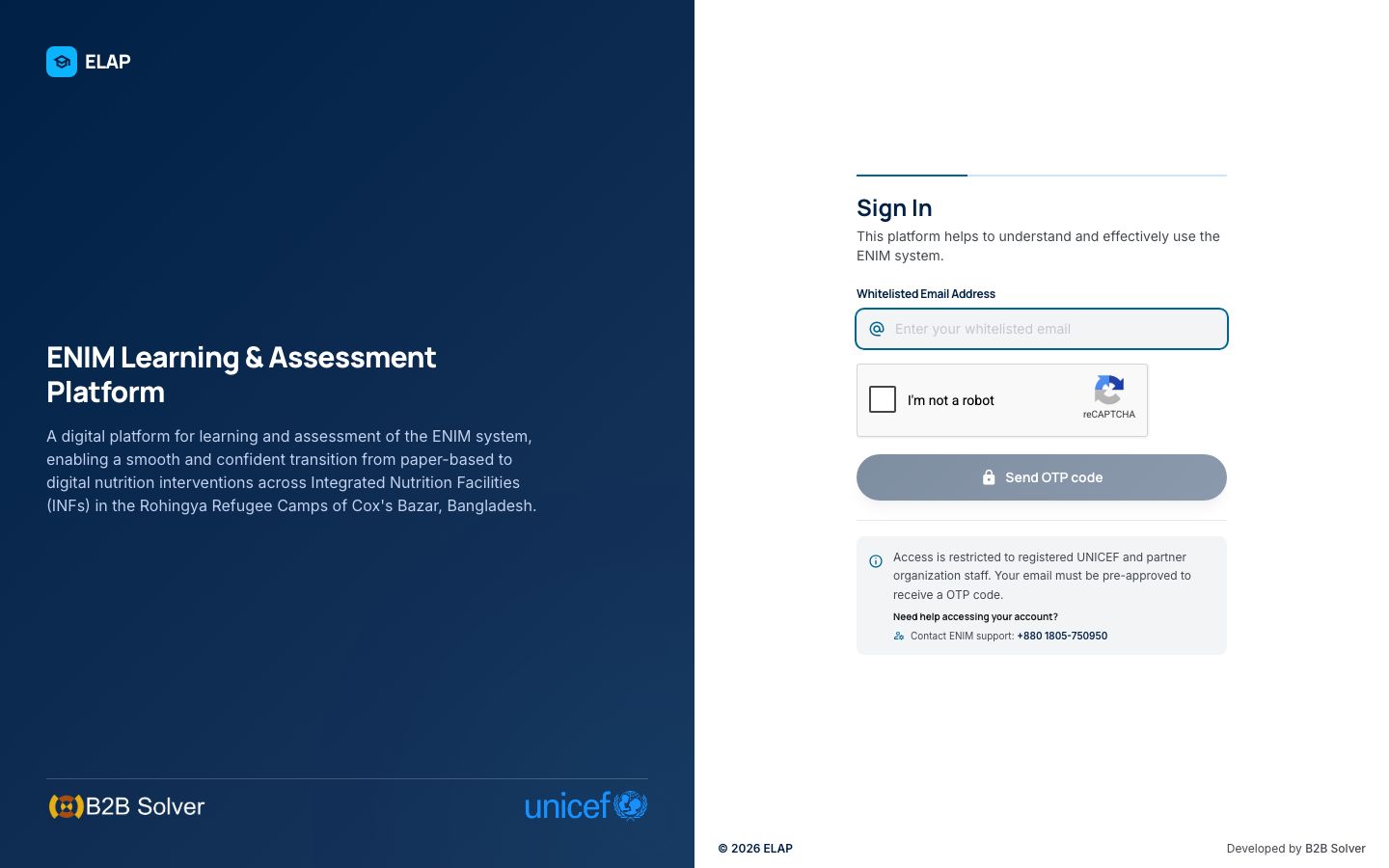
A learning and assessment platform that helps staff at Integrated Nutrition Facilities in the Rohingya camps move from paper registers to the digital ENIM system with confidence.
Read the case study: ELAP →Questions
ENIM is the nutrition information system B2B Solver built for UNICEF and the Nutrition Sector in Cox's Bazar. It replaced 105 paper registers with one case-based record for more than 935,000 people across 33 camps. It is now in version 4.1, developed and maintained by B2B Solver.
Consent, access control and purpose limits are designed in from the start and aligned with each partner's data-sharing agreement. Each user sees only the records their role needs.
Yes. Field teams enter data once, and the system generates the reports each agency needs, such as those for UNICEF, UNHCR and WFP, in their own formats.
Through ELAP, the ENIM Learning and Assessment Platform. Pre-approved UNICEF and partner staff sign in with a one-time passcode and complete courses and assessments on the system they use every day.
Next step
Describe the problem in a few lines. We agree a short call before we propose anything.